
Within the General Ledger, each Ministry and Government entity is separately identified. The budgets, expenditures and revenues for each ministry are posted to the GL either from the other applications or imported from external systems. The GL is used for on-line funds checking, thus preventing ministries from overspending their budgets. The GL operates on an accrual basis for assets, goods and services and a cash basis for manpower and revenue.






Historical overview
The Ministry of Finance and National Economy began shifting from the paper-based system to electronic systems for preparing accounts and managing the state’s budget in the year 1988, by using number of financial systems, which mainly included the following:
About the Central Financial System (CFS)
In line with the government’s policy to unify the enforcement of financial laws and regulations across all ministries, authorities, and public institutions, the Ministry of Finance and National Economy is working to link the budgets of all government entities to the Central Financial System (CFS). This initiative aims to enhance oversight and efficiency in managing the state's general budget, standardize financial procedures and policies, monitor performance, and support decision-making through reliable data and reports provided by the system.
The Ministry began its transition from manual accounting and budget management processes to digital systems in 1988.
Due to limitations in those early systems and the emergence of technical challenges, the Ministry signed a contract with Oracle in 1992 to implement a unified system, known as the Financial Management Information System (FMIS). This system, based on Oracle technology, was launched in 1996 and later became known as the Central Financial System (CFS).
The CFS links the budgets of ministries and government entities under one unified financial platform to strengthen control over budget execution and spending. It also ensures standardization and governance of financial policies and procedures.
In addition, the system includes dedicated environments for government entities with independent budgets, known as Government Funded Organizations (GFO), enabling them to manage their financial operations according to their specific requirements.
Today, the Central Financial System is used by more than 4,000 users across over 100 government entities.
Central Financial System Objectives
The Central Financial System aims to enhance the efficiency of public financial management and promote the highest levels of governance and transparency through the following:
- Optimal utilization of government resources by unifying financial systems, reducing maintenance and support costs, and minimizing reliance on manpower.
- Strengthening expenditure control in budget execution through effective management of authority levels and spending limits.
- Improving the efficiency and speed of financial operations by transitioning to electronic processes and reducing paper-based transactions.
- Providing comprehensive and up-to-date financial data and reports that support government officials in making accurate and timely decisions and assist in financial planning and analysis.
- Ensuring integration between internal modules, which prevents data duplication and errors, while enhancing reliability and user confidence in the system.
Responsibilities of the Ministry of Finance and National Economy
As part of its role in maintaining the system and supporting users, the Ministry of Finance and National Economy provides the following services:
- Connecting government entities to the system
- Managing user access to the system
- Developing financial reports
- Managing system backups and data recovery
- Providing technical support to users
- Organizing workshops and training sessions for users
- Upgrading and enhancing the system
- Integrating external system with the CFS (when needed)
The Ministry of Finance and National Economy remains committed to advancing government financial systems by improving their infrastructure and implementing various projects aimed at meeting the needs of ministries and government entities. These efforts align with national policies that seek to strengthen financial oversight and enhance the efficiency and effectiveness of government operations.
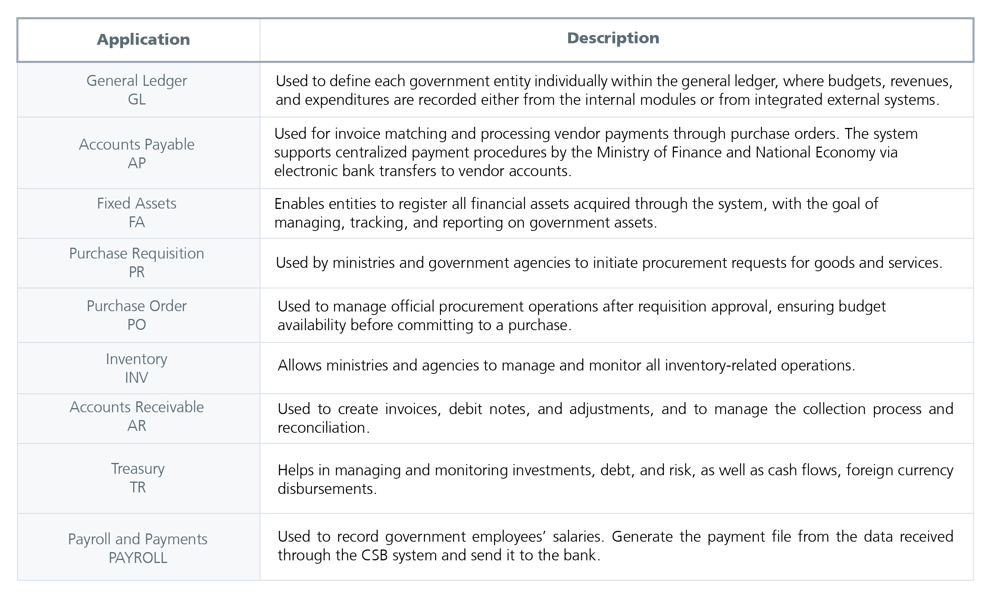
Central Financial System Applications
The system includes a number of essential financial applications used to record and monitor various financial operations, as follows:
Used by all ministries and government entities for creating Purchase Requisitions & Purchase Orders for goods and services. The PR’s & PO’s are checked by the system to ensure that budget is available and reserves the required budget amount, i.e. creates a commitment encumbrance for requisitions while creating an obligation encumbrance for purchase orders. Those ministries which use Inventory (see below) also use Purchasing application for creating requisitions. Requisitions can be raised for either withdrawing stock (Internal Requisition) or procuring stock (Purchase Requisitions). Internal Requisitions are also committed against the budget.
A part of EBS is designed to transform business into an eBusiness. It helps to streamline the procurement process with an end-to end business automation. It provides powerful self-service requisitioning capability with an intuitive, web shopping interface.
Used for matching Invoices with Purchase Orders, recording Invoices, and generating payments to suppliers. The invoices are entered and approved by the ministries. The payment approvals and payments are controlled centrally by MOFNE. Payments to suppliers are made either by a CFS generated cheque or direct credit.
Provides integrated workbenches that can be used to perform most of day-to-day account receivable operations. Transaction workbench is used to process the invoices, debit memos, credit memos, charge back and adjustment. Receipt workbench helps to perform most of the receipt related tasks. Invoices are generated either manually or imported from the operational systems through interface. Miscellaneous Receipts are used for booking the Receipt which is not backed with customer invoice.
Used by ministries for recording and managing their fixed assets. FA calculates the depreciation on assets each month and posts this to the GL along with additions, retirements, and revaluations.
Provides all the required functions for managing, and warehousing stock along with receiving and issuing. INV also includes powerful features for planning, cataloguing, categorizing, and stocktaking. INV is tightly integrated with PO.
Used with Inventory and Purchasing for translating Internal Requisitions into stock issues or back orders.
A bolt-on application developed by MOFNE for paying the government employees’ salaries. Each month the CSB sends a payroll file electronically to MOFNE. The PIPS system translates this file into a series of direct credit files which are verified and then passed to the banks for crediting employees’ bank accounts. PIPS also generates the necessary postings to the GL. The Government’s Human Resource and Payroll systems are hosted on a separate platform under the control of the Civil Service Bureau. The payroll data is periodically interfaced to the CFS General Ledger.
Helps to effectively manage and control cash flows, foreign exchange and money market deals and overall risk. It provides comprehensive bank relationship management, settlement features and flexible position reporting.
Used by MOFNE for the reconciliation of the centrally held bank accounts.

Central Finance System (CFS)
In-line with Bahrain’s 2030 vision and in pursuance of exceptional performance and execution excellence; MOFNE consistently strives to be at the forefront of innovating and transforming its operations and services in a way that aligns with the ambitions of the nation, its leaders and global best practices.
At MOFNE, there is a continuous and close collaboration between our staff and leadership to discuss and innovate methods in which we not only aim to improve our internal processes and service offerings, but to extend those improvements to all of Bahrain.

Purpose
An Analytic tool enabling users to access financial (General Ledger) dashboards and reports in an easy-to-read format on Web and Mobile applications.

Benefits
- Provides insights into MOFNE’s Budgets and Expenditure information.
- Easier retrieval of data available in the Central Finance System on Web and Mobile applications, providing users the ability to make more informed business decisions.
- Easy creation of customized & configurable reports & analytics.
- Provides the ability to create custom notifications & alerts that are tightly linked with various business activities.
Purpose
A tool to accelerate real-time retrieval and analysis of financial information as well as reports creation by utilizing the power of Microsoft Excel.
Benefits
- Provides seamless interaction with data available in MOFNE’s financial systems, allowing for easier analysis & creation of operational level reports for more informed business decisions.
- Increases the efficiency of the day-to-day financial analysis operations and accelerates various processes (e.g. month-end close).
Purpose
Increase the efficiency, controls & data accuracy of various processes by utilizing Intelligent & Robotics Process Automation.
Benefits
- Automatic execution of processes, replacing manual intervention and leading to a higher accuracy in output.
- Automate repetitive processes to allow resources to focus on value added activities.

Introduction
In 2022, MoFNE has implemented a solution to automate the processes of preparation and management of planning and budgeting processes using a world-class solution (Oracle EPM, Hyperion Planning), the system called Central Planning & Budgeting System (CPBS).

Project Architecture
Objectives
The CPBS project aim to achieve the following objectives:
- Improve Efficiency:
Highly improved efficiency in planning and budgeting processes through the automation of currently manual planning, budgeting, forecasting processes. - Elimination of the usage of spreadsheet templates in budget formulation, submission and reviews.
- Ensured accuracy with a centralized, single-data repository that validates budgets.
- Advanced modeling and ‘what-if’ scenario analysis.
- Fully automated budget execution ensures effective government funds management.
Collaboration and Simplicity:
Centralized and uniform planning and budgeting models and improved collaboration and accountability across planning, budgeting and forecasting processes through the usage of system workflows.
Improved timeliness in reporting via monitoring of progress of planning, budgeting and forecasting cycles.
Automated Data Integration:
Complete integration between MOFNE source systems and Oracle Hyperion Planning applications to ensure singularity and reliability of data across all financial systems.
Insightful Reporting:
Automated generation of financial reports that are furnished with key business KPIs.
Key Benefits of Project Implementation
- Fully Automate the processes and get rid of Physical documents.
- Decrease the Budget submission from 6 months to 1 month.
- Ease of analysis and extraction of reports.
- Fewer errors in the process of entering and approving budget distributions..
- Less time in the process of entering and approving budget distributions.
- Better control and compliance with the instructions for preparing and entering the budget.


Transformation